-

As artists we are always developing. I started this site some years ago to monitor my progress at art classes. Some areas have improved faster than others and I expect this to continue to be an interesting journey. Constructive comments are always welcome. Steve.

Saturday, May 24, 2008

Sunday, April 13, 2008

Friday, March 28, 2008

Loch Creran - Ink Sketch


Small sketch in ink (6"x4"). More of a practice than a proper work.
This is one of the views up Loch Creran from the Scottish Sealife Sanctuary which is about five minutes up the road from home. There was plenty of fresh snow on the hills which kept disappearing under cloud. As it was quite cold and showery I did the outline sketch on the spot and completed it back at home.

Monday, March 24, 2008

Glen Sallach


Ink,Pencil and Charcoal drawing of Glen Sallach on A2 size paper.
The glen is located on the eastern side of Ben Lora a couple of miles (as the crow flies) from Benderloch.

Monday, March 17, 2008

Highland scene


Acrylic 16"x12" mainly painted using knife.
The scene is loosely based on Glencoe.
Completed 17 March 08.

Sunday, March 09, 2008

"Inktense" one-day course

I went to a one-day course at the Appin Art Group about how to use the recently introduced Derwent Inktense pencils. We had demos from the tutor Tony Hogan and opportunities to practice using the medium.


(Remember to click on the images to view larger)

Below are my learnings and thoughts about Inktense.

Inktense look like ordinary colouring pencils. The pigment is a solid, water-soluble acrylic. Your picture won't look very impressive at first if you simply draw using the pencils. But add water from a wet brush to the lines and vibrant colour floods out, mixing and blending under the control of your brush. The final colour will be more intense than the solid tip of the pencil appears so its useful to keep an example palette handy.

Tony showed several ways of using the Inktense pencils - a typical painting would probably utilise them all. The pencils are generally used like watercolour pencils.
This means -
1) the colour can be drawn straight on to the paper and water added for strong acrylic-like effects;
2) the ink can be transferred to the brush by stroking the tip of a damp pencil, to add emphasis or to draw with the brush;
3) use it like watercolours by drawing a dry paper palette swatch then lifting the paint onto the wet brush for painting.
-----------------------------------
Strong acrylic technique.

eg a mountain scene - draw bold strokes using several colours with gaps between. Use a wet brush to stroke over. The colour floods out and intensifies while adjacents mix and blend. Good for general effects; harder to control for accuracy. If you are looking for accuracy of representation use the watercolour method (below) to lay down an underpainting and build up from it. You can paint light over dark with Inktense, but obviously life is easier if you don't have to do that. The technique is also good for large areas of underpainting in one colour before doing more detailed work using paint as below. (NB Inktense can be used this way on dark, even black paper.)
-----------------------------------
Watercolour technique.

On a spare piece of paper roughly draw some swatches of each colour. Use a brush to wet one half and draw the colour out to see different intensities. Then using a clean, damp brush rub it over the colour to lift some from the swatch at the intensity you desire and apply to the picture. You must wait a short while for the colour to dry then you can add another layer of colour. This good for building up intense colour using glazing technique. Remember to always clean the brush.
Bear in mind that the painted result will be more intense towards that part applied with the tip of the brush and this can result in unwanted strong edges. Not really a problem unless you don't notice it. Like watercolours it can be difficult to hide the edge later. Unlike watercolour though you can apply a stronger opaque colour over it (or cover with some white acrylic paint and restart the area).
-----------------------------------
Wet tip technique. Dampen the tip of the pencil. This softens the paint and it can e lifted off onto a brush. Useful for getting stronger colour onto the brush than the palette method. You can also use the pencil tip to apply colour directly. It tends to be pretty intense colour if applied directly though. One use of this trick is to add snow to tops of mountains - dampen the end of the white pencil then "roll" the pencil across the picture - don't draw as it won't work - its a kind of dabbing process which adds highlight spots.
--------------------------

My practice piece of work done during the course

Not very exciting, but a useful demo of how the intensity can be varied and colours overlaid - especially useful in this scene with the water reflections.

--------------------------
Back home, I made this piece

"Late afternoon, Bamburgh Castle, Northumberland"
Done on acrylic paper 12"x8". It's nearly all Inktense with some of the white highlights on the waves added using neat acrylic paint.
--------------------------
Overall Inktense should be a useful addition to one's art box - especially for plein aire painting. Combine Inktense with a Pentel Water Brush* and this could be one of the most convenient sets of kit for outdoor painting.
Steve Eccles, March 08.

*This is a synthetic tipped brush with refillable water chamber. Eliminates need for water jars etc. In the Pentel UK online catalogue its code is "Water Brush Product Code: FRH."

Sunday, March 02, 2008

"Natural Forms"


"Natural Forms"
Size A2 This an exercise to use pencil, ink and charcoal.
The objects should show some natural textures.
Hopefully you can see seaweed, a shell, an onion, some potatoes, a dried Honesty plant stem lying down and some dried wheat and allium heads in the vase. Behind the vase is a wood log and on the window ledge a cyclamen plant sits beside a copper kettle.

Wednesday, February 20, 2008

A couple of A6 sketches


Poinsietta in a pot.


Cottages, Benderloch.


Tuesday, February 19, 2008

Barn at Benderloch


This Barn is at Selma, Benderloch, by the track leading down from the church to the beach. I painted it in Feb07 as part of an internet art group challenge. The setting is in summer with a bit of artistic licence.
Details: Painted in acrylics on heavy paper 16"x12".
I mainly used a knife with some finishing and glazing using brushes.

Sunday, November 25, 2007

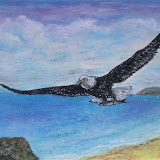
American Bald Eagle with a Fish

An American Bald Eagle with fish. Painted as the Nov07 web group challenge. I started this as a pen-and-ink drawing and decided to add colour using pastels. A4 size.

Bald Eagle - how I painted it

Click on the Speech Bubble at lower left of the video to turn on the subtitles.

Bald Eagle more detail

Click on the image below to see the photos in a larger format the select Slideshow to read my comments on the images.
Painting project - American Bald Eagle with fish

Monday, November 19, 2007

Burano Canal, Venice

Acrylic, mainly painted with knife 10"x8".

Friday, November 16, 2007

Mangastera Beach mosaic


This is another kind of digital "painting". I took the photo of my original Mangastera Beach painting (see below) and put it through a computer program called Easy Mosaic. It uses other pictures to produce the mosaic effect which become visible when you enlarge the resulting image. The file it makes is too large to load here. If you copy the larger version of this image you should be able to enlarge it and get a better idea of the effect. Even then the compression doesn't really do it justice. It was an amusing exercise but I don't think I'll do it again. There's a much better example here which uses a web player to good effect by letting the viewer keep zooming in to see pictures made from pictures, which in turn are made from pictures.

Saturday, November 10, 2007

Sea & Island - a digital creation


This was "painted" using a digital art program called Twisted Brush which members of my internet art group are all playing with. The 'beaten silver' look was applied later using Photoshop.

Friday, November 02, 2007

Mangersta Beach


"Mangersta Beach on Isle of Lewis" in pastels 16"x12".

Sunday, October 07, 2007

White-tailed Deer


White-tailed Deer
Pastel 16"x12" from a photo of the partially hidden deer. The grasses in the source picture were more of a distraction than an interest - which is reasonable since the deer was using them as camoflage - so I've changed that to try to give the impression that the deer is standing to the side of a "path" through a field of swaying corn (or something like that!).

Monday, August 20, 2007

Abruzzo Abstract


Abruzzo abstract. August 2007.
Pastel on paper. 30x30 cm. (approx. 12"x12")
Inspired by a castle in the Abruzzo region of Italy.

Roller (1)


This is an acrylic I'm currentky working on.

Thursday, May 31, 2007

Art group challenges


This was the result of a challenge posed by an internet art group to produce a work from a photo they supplied - but done in just one session. I used pastels - don't know the location, but guess probably USA.


I called this acrylic piece "Glen Presto" as it was done fairly quickly just using paints which were "leftovers" on my palette.


This is a charcoal and white chalk work on paper. The scene is from a 1960's photo of a steam train leaving Benderloch station. The challenge was to "extend" the composition onto the mount or frame.